The REACH For the Future Conference is now done for 2015! Wow, what a year it was!
The first day was Challenge Day. Students were challenged to drop the water line, to discard their “fimage” or fake image, and to show people who they really are. They were encouraged to share their hopes, dreams, fears, successes, and failures with their family groups. Later in the night, continuing along with the idea of dropping the waterline, students were asked to cross a line if certain powerful statements applied to them. Statements like “If you know anyone who has died,” or “If you or your family or a close friend have struggled with addiction,” were made and students slowly dropped the water line and put themselves out there. By the end of the night, students realized they everything they struggled through were things that most other people in the room had struggled through also. Students left feeling more connected to their peers, and feeling less lonely.

Students took a hike day two to get away from it all for a little bit and were treated to quite the view along the way.
Day two of Reach for the Future was all about the brain! Students attended workshops during a huge chunk of the day, hoping to be further educated on everything from the dangers of alcohol, to the dangers of stereotyping. Students learned, among other things, how to be in healthy relationships, how to take care of themselves mentally and physically, how to break down barriers to uncover diversity and how to spread a message of hope and speak against hate and intolerance. Participants also had to amazing chance to listen to Stu Cabe, a key note speaker whose humor and wit helps tell the story of wild elephants while actually teaching youth about how to be better individuals. After our workshops, students got together in their school groups and played a series of games to strengthen their bonds as a school, led by the one and only Rick Minniefield. The students within Butte County got a chance to show off what their schools had been working on that year in regards to their School Climate/Merchant Committed/Parent Committed projects after the games were all finished. Out of county schools got a chance to see what it takes to implement these projects and get directions on how to implement these projects as a school.
As day two carried on, students got to take a break during free time, going on a hike, doing crafts, playing basketball, or just hanging out with friends. Jamba Juice even showed up and provided refreshing drinks to the tired students. Later that night was my personal highlight; talent show! Participants had the opportunity to get up in front of 300 of their peers and show off their talents. Talk about bravery! Students danced, sang, did plays, told jokes, and showed off their various instrumental talents. It was truly quiet a show. The night ended with a dance and a blessing from keynote speaker Maggie Steele.
Day three is easily one of the most fun, and physically exhausting days; the Odyssey Ropes Course, hosted by Odyssey Teams. Students get to participate in four different activities.
1. The Wall

Youth Staff employee John Vang gets helped over the wall while participants around him raise their hands up to catch him if he falls. Students on top reach down to help John get over the wall.
The wall is easily one of my favorite events we do up at REACH. Students gather around 15 foot wall made of scaffolding and cloth. This wall is not able to be climbed all on its on. It requires the help and support of many people. One at a time, the participants approach the wall and are immediately surrounded by their peers, for both emotional and physical support. The participant states what this wall represents to them, before being pushed and hoisted over by their peers. All participants have their hands up, ready to catch the person if they fall. The wall speaks to me ever year and I can’t help but have respect and adoration to those students who are brave enough to allow themselves to rely on others to get over the wall.
2. The Flying Squirrel
The Flying Squirrel is a rush, to say the least. Every there is a not so quiet buzz around day three that emanates around the words “Flying Squirrel.” Some students talk excitedly about the next time they get to “fly high”, while newcomers listen in, with only slightly concerned looks on their faces.
The Flying Squirrel is essential a 50ft slingshot. Two students are strapped into harnesses and then into ropes that attach to two poles at the top, and then come down to two groups of participants, ready to pull the pair as high as they can.
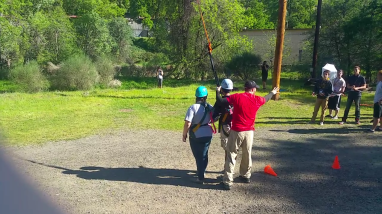

With a “support team” ready yelled from both groups of pullers and a proclamation of “flying” by the two lucky participants, and a final “fly high!” from the whole group, everything moves quickly. The two flyers run quickly towards the center of the poles while the two support teams grab the ropes and run as fast as they can. About ten seconds later, both support teams have passed each other and the flyers are fifty feet up in the air, either screaming, giggling, or both, simultaneously.
3. The Tower
The Tower sounds a bit more daunting than it actually is. The Tower is a rock climbing wall. Students must work together to climb the wall, as they are attached to each other at their harnesses. If one student wants to give up, the other student is there to encourage them.


Participants start climbing the wall with the goal of ringing the bell at the top.
Students first find a partner and then get harnessed up. Once ready, students approach the wall and the instructor yells out “choice at the wall!” At that point the rest of the team comes over and places a hand on the shoulders of the climbers or on those standing in front of them. The two climbers state who they are climbing with and state a relationship in their life that they want to work on, be it with their mom or dad, brother or sister, friend or teacher. Then they start climbing, their goal being to reach the top and ring the bell. From the ground, their whole team cheers them on, offering support, encouragement, or advice on how to get even higher if they get stuck. Regardless of if they rang the bell or not, students are cheered on as the descend, and congratulated as their feet touch the ground.
4. Chau Yoder
It seems like every year that Odyssey brings in a new station for day three. This year we had the chance to meet Chau Yoder, a lady who specializes in focus, meditation, and breathing. Chau led the groups through a guided mediation focusing on breathing and being present in the moment. Once that was done, students learned about how to balance their lives, and to take every moment with purpose, to take every step with intention. Participants got to practice walking slowly while being purposeful with their breathing, allowing the inhaling and exhaling to sync with their footsteps. Lastly, students lied down, closed their eyes, and took 10 minutes to meditate while being guided by Yoder’s voice. Despite lying on the hard ground, it did not take many people very long to doze off, falling deeply into their mediation. When the 10 minutes were over, everyone woke up feeling refreshed an ready to continue their day. Reach can be so hectic sometimes, so sometimes we forget that we need some quiet time, to take care of our bodies and our minds. Yoder’s workshop was a breath of fresh air in the middle of a busy day. It was a time to be refreshed and gain a new perspective on how the rest of the day was going to be spent.
With the ropes course complete, it was time to wrap up our weekend together. Participants spent the last hour or so hearing highlights from returning and new participants and adult advisors. Butte County staff also had a chance to share some of their highlights. Lastly, participants got the opportunity to watch the video that was made during REACH. when the video was done, good-byes were said and students made their way up to their buses, frantically exchanging information, hugging, signing shirts, and saying goodbye to all their new friends. Like many other were thinking as they got in their buses to go home, I will end it with this, “Until next year!”


 Butte Youth Now